Air conditioning for a loft bedroom or loft conversion
If you sleep in a loft room, you already know the problem: on a hot day it's the hottest room in the house by a wide margin, and it stays that way long after midnight. This isn't bad luck — it's physics working against you three times over — and it's why half-measures that work fine downstairs barely register up there. Here's what's actually going on and what genuinely fixes it.
Why loft rooms overheat so badly
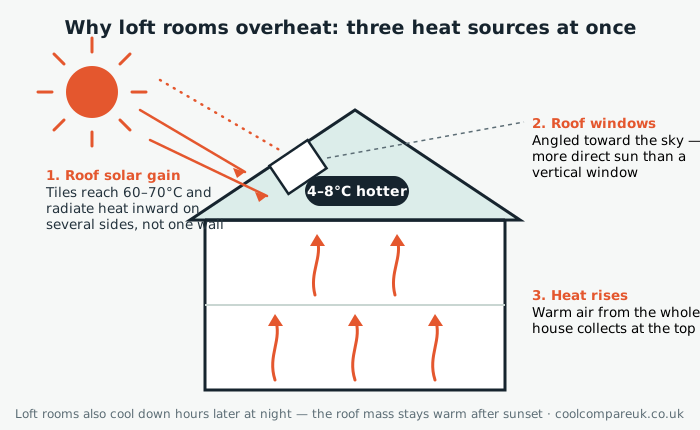
Three things stack up. First, heat rises — your loft room sits at the top of a column of warm air produced by the whole house, so it starts every evening with a temperature handicap. Second, the roof is a radiator in reverse: tiles bake in direct sun all day and can reach 60–70°C on their surface, and even a well-insulated loft conversion sits centimetres from that heat source on several sides at once, not just one wall. Third, roof windows are skylights for solar gain — Velux-style windows angle toward the sky and admit far more direct sun than a vertical window of the same size, and they're usually the only ventilation you have.
The result: loft rooms routinely run 4–8°C hotter than the ground floor, and because the roof mass stays warm into the night, they cool down hours later than the rest of the house. That's exactly the pattern that ruins sleep.
What doesn't work (or only half-works)
- Fans alone move warm air around; above about 26–27°C they stop helping much and above ~35°C they can make things worse. Fine as a supplement, not a fix.
- Opening the roof window at night helps if the outside air has cooled, but during heatwave nights that often doesn't happen until 3–4am — and it lets warm air in during the day if you forget to close it.
- Blackout blinds on roof windows are genuinely worth doing — external or reflective blinds cut solar gain meaningfully — but they slow the heating rather than remove it. Do this and something else.
- Evaporative "air coolers" add humidity to a warm sealed room. In a UK loft in July, they are close to useless.
Option 1: a portable air conditioner — workable, with caveats
A portable unit can hold a loft bedroom to a sleepable temperature, but lofts expose every weakness portables have. You need somewhere for the exhaust hose to go, and loft rooms usually only have roof windows — sealing a hose kit against an angled, top-hinged Velux is awkward, though purpose-made roof-window seal kits exist for around £25–40 and make a real difference (see our window kit guide). Because the heat load is higher than the floor area suggests, size up: treat a loft like a sunny room and pick at least a 9,000 BTU unit for a typical loft bedroom, 10,000–12,000 for a large one (run your numbers through the sizing calculator with sun exposure set to "sunny"). And there's noise — 50–65 dB in the room you're trying to sleep in. Many people run the unit hard for two hours before bed, then switch to fan or sleep mode.
Realistic verdict: right choice if you're renting or the loft gets uncomfortable a few weeks a year. See our current portable picks. If you own the house and this happens every summer, read on.
Option 2: a split system — the proper fix
A wall-mounted split system is the answer that actually solves a loft room, for the same reasons the room overheats: it has the capacity to fight the roof's heat load continuously, it does it at ~19–30 dB indoors (quiet enough to sleep under), and because nearly all modern splits are reversible heat pumps, it also fixes the loft's winter problem — these rooms lose heat through the roof as readily as they gain it in summer.
Lofts do add some installation quirks worth knowing before you get quotes:
- Sloped ceilings limit where a standard high-wall unit can go. Installers typically use the gable-end wall, a low-level console unit (mounted near the floor like a radiator), or occasionally a compact ceiling cassette in a flat section.
- The outdoor unit and pipe run — the condenser usually sits at ground level or on a flat roof, which can mean a longer pipe run up the outside of the house than a ground-floor install. Longer runs and working at height are the two things that push loft quotes toward the upper end of the normal £1,500–£3,500 single-room range.
- Condensate drainage needs a route — usually along the pipe run — which is routine for an installer but worth asking about in the survey.
- Planning — since May 2025, a reversible heat/cool unit on a house usually falls under permitted development (see our planning permission guide); it's rarely a blocker for a loft conversion on a normal house.
None of these are exotic. Loft bedrooms are one of the most common single-room split installs in the UK precisely because the problem is so acute — any experienced installer has done dozens.
What it costs for a loft specifically
| Option | Typical cost | Holds a heatwave night? |
|---|---|---|
| Roof-window blinds + fan | £100–£300 | Takes the edge off, no more |
| Portable AC (9,000–12,000 BTU) + window seal kit | £330–£640 | Yes, with noise and hose faff |
| Single split system, installed | £1,800–£3,500 | Yes — quietly, cheaply, and it heats in winter |
Running costs favour the split heavily: roughly 10–50p per hour versus 25–35p for a portable delivering less cooling — and the split's winter heating offsets more of its cost every year you own it.
Next step: size your loft room properly (set sun exposure to "sunny" — the roof counts), then get up to three free quotes from F-Gas certified installers. Mention it's a loft conversion in the form — installers will price the access and pipe run realistically first time.
Quick answers
Can a split system be installed if my loft has no flat exterior wall?
Almost always yes — installers use gable ends, low-level console units under the eaves, or run pipework to a unit on a lower wall. It's a survey question, not a dealbreaker.
Will a portable AC hose work with a Velux window?
With a purpose-made roof-window seal kit (around £25–40), yes. A DIY board-and-tape arrangement also works but leaks more warm air back in. Without any seal, you lose a large share of the cooling.
Is it worth doing insulation and blinds before buying AC?
Blinds, yes — cheap and immediate. If your loft conversion is older and under-insulated, improving it helps both seasons, but it won't make a loft bedroom heatwave-proof on its own. Most people do blinds plus AC.